
Choosing an international business partner is not just about market size or opportunity — it’s about compatibility. Every region has its own way of financing deals, negotiating agreements, building trust, and regulating businesses.
As global trade evolves, traditional Western markets are no longer the only destinations for growth. Fast-growing economies such as China, India, Turkey, and the United Arab Emirates are becoming increasingly important players in international trade.
For entrepreneurs, business leaders, and African SMEs looking to expand internationally, understanding how these markets operate can make the difference between a successful partnership and a difficult one. Below is a simple breakdown of how these four markets differ.
China
- Financing Culture: How Business Deals Are Funded
When working with Chinese partners, financing often involves government-backed institutions and large state-linked banks. Financing for trade and infrastructure projects often depends on strong relationships with these institutions. As a result, Chinese companies tend to focus on long-term strategic partnerships rather than short-term transactions.
- Negotiation Styles: How Business Relationships Are Built
Business negotiations in China are strongly relationship-driven. Trust, reputation, and long-term commitment are highly valued. Building personal relationships often through meetings, dinners, and social interactions is usually an important step before finalizing deals.
- Regulatory Risk: Navigating Business Rules
While China offers massive market scale, its regulatory environment can be complex. Trade rules and compliance requirements may change depending on government policies or geopolitical developments. Many companies work with local agents to help navigate these changes.
- Sector Opportunities: Where Each Market Excels
Low cost manufacturing, electronics, infrastructure development, and solar energy components.
India
- Financing Culture: How Business Deals Are Funded
India’s trade finance system combines traditional banking with newer financial initiatives. For example, India has introduced local currency settlement arrangements that allow some trade to be conducted in Indian rupees instead of foreign currencies. This can reduce exchange-rate risks for businesses.
- Negotiation Styles: How Business Relationships Are Built
Indian negotiation styles can be flexible and adaptive, mixing hierarchy with informality. Senior decision-makers typically play an important role, but discussions may involve multiple rounds of engagement before agreements are reached. Building trust through continued interaction is key.
- Regulatory Risk: Navigating Business Rules
India’s regulatory system has improved over the years but still includes challenges such as quality certifications, sector-specific compliance and slow bureaucratic procedures. A common strategy is to start with smaller projects before expanding into larger partnerships.
- Sector Opportunities: Where Each Market Excels
IT and software services, pharmaceuticals, textiles and agricultural processing technology.
Turkey
- Financing Culture: How Business Deals Are Funded
Turkey encourages investment through government-backed initiatives and public–private partnerships, particularly in sectors such as manufacturing and technology. Access to capital can therefore be relatively flexible for strategic industries.
- Negotiation Styles: How Business Relationships Are Built
Turkish business culture combines European-style professionalism with Middle Eastern hospitality. Turkish partners value direct communication and clarity when it comes to contracts and expectations. They value quality and “brand prestige.” If your product looks cheap, the conversation ends quickly. As much as contracts and clear agreements are important, personal relationships and direct communication also play a significant role in building trust.
- Regulatory Risk: Navigating Business Rules
Turkey maintains strong trade ties with the European Union, meaning many of its product standards align with EU requirements, creating clear quality expectations. Regulatory changes related to political and economics shifts can affect certain sectors, hence, due diligence is critical.
- Sector Opportunities: Where Each Market Excels
Textiles, furniture manufacturing and high-quality construction materials.
United Arab Emirates (UAE)
- Financing Culture: How Business Deals Are Funded
The UAE is known for its business-friendly investment environment. Free zones offer incentives such as tax benefits, full foreign ownership, and easy profit repatriation. These policies have helped the country attract global investors and multinational companies.
- Negotiation Styles: How Business Relationships Are Built
Business negotiations in the UAE tend to move quickly. Due to the country’s global business exposure, many negotiations follow international standards. Partners often expect efficient communication, clear proposals, and strong legal structures.
- Regulatory Risk: Navigating Business Rules
The UAE is widely regarded as one of the easiest places to do business in the region. Regulations are generally transparent, and processes such as licensing, visas, and company registration are streamlined, particularly in free zone, making it the easiest of the four to set up a physical presence.
- Sector Opportunities: Where Each Market Excels
Financial services and emerging green technology industries.
A Quick Comparison
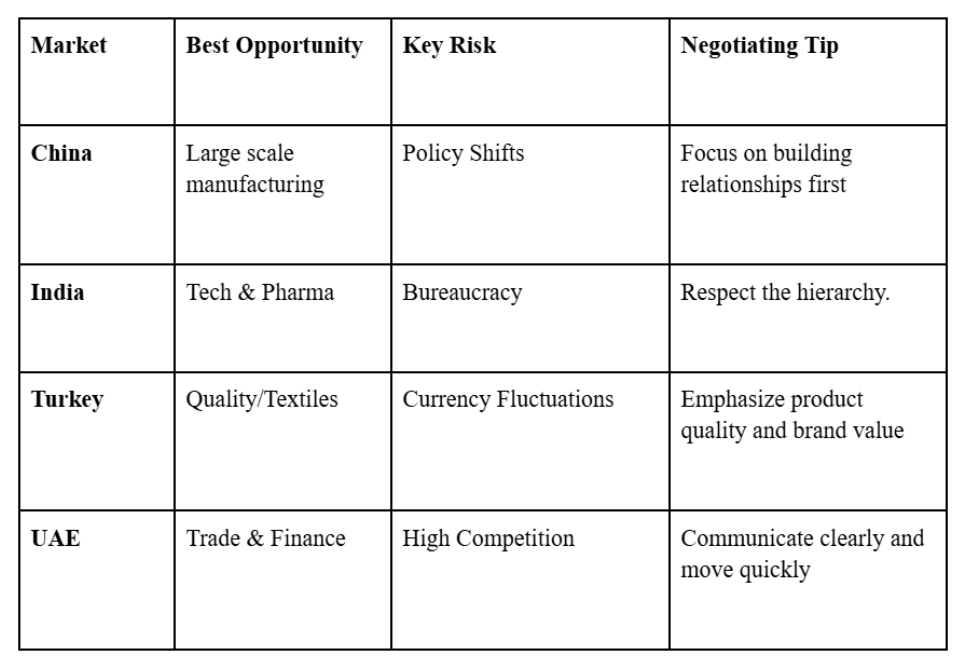
Takeaway
Choosing the right emerging market partnership is built on insight, it is about understanding how each market thinks, funds, and regulates business. Whether you’re a CEO, SME owner, or strategic planner, by aligning your business strategy with the strengths and realities of each market, companies can build partnerships that are more sustainable and scalable in the long term.
Which of these markets best fits your business expansion plans?